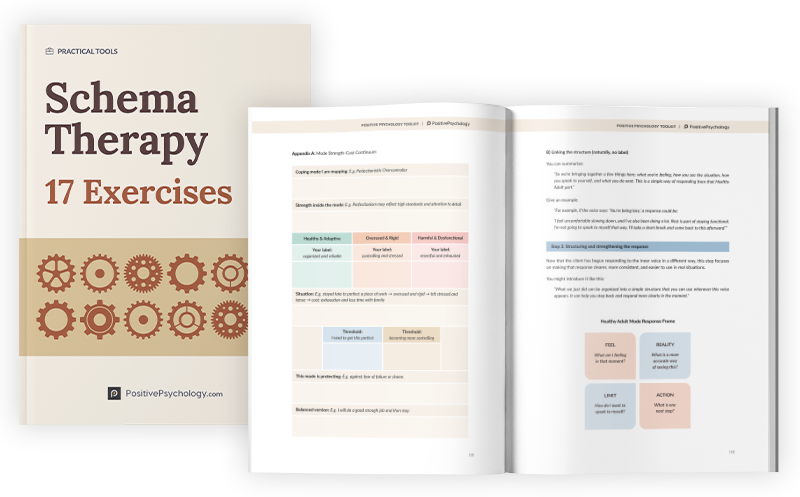
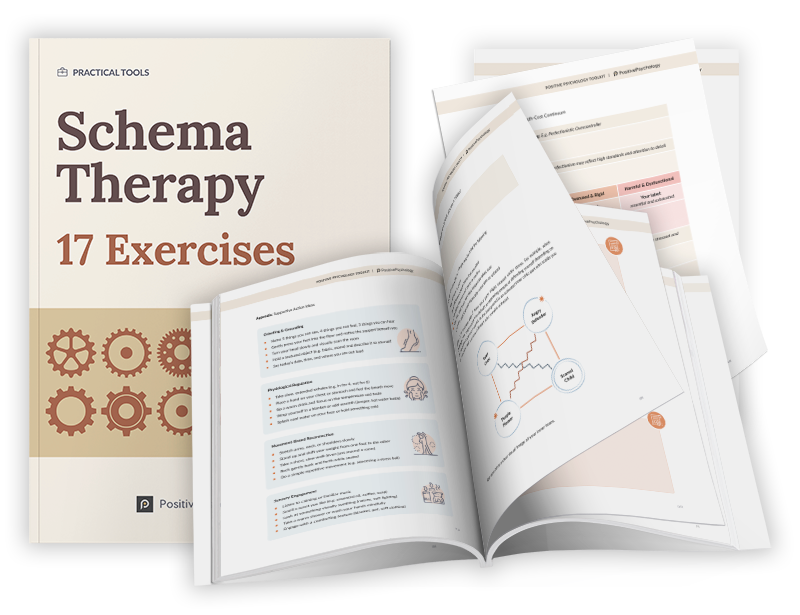

17 Schema Therapy Exercises

Tools
(4 customer reviews)

Recurring emotional patterns can shape how people think, feel, cope, and relate to others โ€” often outside conscious awareness. Many individuals find themselves caught in cycles of self-criticism, emotional avoidance, perfectionism, people-pleasing, relational conflict, or overwhelm, even when they intellectually understand these patterns and genuinely want to change them. Schema therapy helps uncover the deeper emotional roots behind these experiences by exploring how unmet emotional needs and early life experiences shape enduring schemas, coping responses, and relationship dynamics.

These 17 evidence-based exercises translate insights from schema therapy, attachment theory, emotion regulation research, experiential psychology, and cognitive-behavioral science into practical, emotionally grounded interventions. Rooted in both scientific research and therapeutic application, this tool pack helps individuals recognize maladaptive schemas, understand coping modes, process unmet emotional needs, strengthen Healthy Adult functioning, and develop healthier, more adaptive ways of relating to themselves and others.

Each exercise is carefully designed to create meaningful impact across therapy, coaching, educational settings, group work, and personal development practice โ€” helping individuals move from automatic survival patterns toward greater emotional awareness, self-compassion, psychological flexibility, and lasting emotional and relational change.

$ 35

You will be equipped with the following tools:

  • Differentiating Detachment from Regulation Tool

    Help clients distinguish detachment from genuine nervous-system regulation and restorative calm.

  • Embodying and Shifting Schema Modes

    Help clients move schema work from cognitive insight into embodied awareness by physically enacting specific modes and deliberately shifting into a โ€œHealthy Adultโ€ embodied state.

  • Emotional Needs Fulfillment Inventory

    Help clients identify which core emotional needs feel supported in their current life, which needs may be undernourished, and how they tend to cope when these needs are not met.

  • Happy Child Strength Activation

    Help clients reconnect with and experience their Healthy/Happy Child mode, making it easier to access this state and bring more lightness, flexibility, and enjoyment into their daily life.

  • Healthy Adult Capacity Assessment

    Help practitioners evaluate the strength, accessibility, and consistency of Healthy Adult functioning across key domains.

  • Healthy Adult Functioning Under Stress

    Support Healthy Adult functioning; the mode associated with balanced reasoning, compassion, emotional regulation, and adaptive functioning.

  • Healthy Adult Values Alignment Tool

    Help clients distinguish between decisions driven by Coping modes and those guided by the Healthy Adult.

  • Identifying Schema Coping Styles

    Help clients identify their dominant schema coping styles across different life domains, including relationships, work and daily functioning.

  • Inner Team Integration

    Help clients reduce internal fragmentation by identifying and mapping their โ€œinner teamโ€ of parts, modes, or ego states.

  • Mapping Child Mode Activation Patterns

    Help clients distinguish between Child modes by recognizing each modeโ€™s triggers, emotional tone, somatic signals, and behavioral patterns.

  • Weekly Schema Mode Tracking Log

    Make the first step to slow down automatic emotional responses by systematically tracking schema mode activation in daily life.

  • Mode Strength-Cost Continuum

    Help clients recognize how their coping patterns function across a continuum, from helpful and adaptive, to rigid and overused, to emotionally or relationally costly.

  • Mode-Specific Recovery Strategies

    Support practitioners in guiding clients to identify their active coping mode and collaboratively select interventions that are functionally matched to that modeโ€™s protective purpose.

  • Parent Mode Deconstruction & Rebuild

    Help clients recognize and deconstruct Punitive and Demanding Parent Mode messages and transform them into Healthy Adult responses.

  • Reclaiming Healthy Anger

    Help your client differentiate healthy anger that signals injustice and boundary violations from reactive, defensive, and suppressed anger rooted in maladaptive schemas.

  • Shifting from Mode Reactivity to Adult Relating

    Help clients identify recurring schema mode-driven relational cycles and shift toward Healthy Adult relating.

  • The Grief of What Wasnโ€™t

    Help clients process grief related to unmet developmental needs in a structured, adult-led framework.

  • [BONUS] Mapping Countertransference Patterns

    Help practitioners identify patterns in their countertransference reactions by mapping which client behaviors activate their personal schemas, emotional responses, and coping modes.


๏ปฟ๏ปฟ๏ปฟThis pack includes 17 evidence-based schema therapy exercises designed to help clients identify maladaptive schemas, understand coping modes, and strengthen Healthy Adult functioning across personal, relational, and professional contexts. Each activity supports greater emotional awareness, psychological flexibility, and more intentional responding โ€” especially during moments of emotional activation, relational conflict, self-criticism, or overwhelm.

Rooted in schema therapy, attachment theory, emotion regulation research, and experiential psychology, the exercises provide structured guidance, reflective prompts, and practical therapeutic applications. Whether supporting clients in recognizing survival patterns, processing unmet emotional needs, improving relational dynamics, developing healthier boundaries, or cultivating self-compassion and internal balance, this toolkit offers a flexible framework for meaningful psychological growth and lasting change.

Download the pack to help clients move beyond automatic survival patterns and build healthier, more adaptive ways of relating to themselves and others.

The following experts create our tools and resources:

  • Jo Nash

    Ph.D.

  • Lorena Berber

    M.Sc.

  • Emma Mudge

    BSc (Hons), PGCert, PGDip

  • Lara Catic

    M.Sc.

This resource is designed for anyone who wants to better understand the emotional patterns, coping responses, and relational dynamics that shape their thoughts, behaviors, and relationships. It is ideal for individuals seeking practical, evidence-based tools to build emotional awareness, regulate reactivity, strengthen self-understanding, and respond to lifeโ€™s challenges with greater flexibility and balance. It is also well-suited for therapists, coaches, counselors, educators, and other helping professionals who support clients in identifying maladaptive schemas, navigating attachment-related patterns, strengthening Healthy Adult functioning, and developing healthier ways of relating to themselves and others.

These tools are designed for adults who want to better understand and change long-standing emotional, cognitive, and relational patterns. They are suitable for a wide range of life situations, including relationship difficulties, attachment-related challenges, self-criticism, emotional overwhelm, workplace stress, boundary struggles, and periods of transition or personal growth. Flexible and adaptable, the exercises support adults in strengthening emotional awareness, improving psychological flexibility, developing healthier coping responses, processing unmet emotional needs, and building more balanced, compassionate, and resilient ways of relating to themselves and others.

These tools are designed to be simple, flexible, and easy to integrate into everyday life. Each exercise includes clear instructions, practical guidance, and step-by-step support to help users apply the techniques effectively. They can be used independently for personal growth or incorporated into existing coaching, therapeutic, or wellbeing practices - allowing you to adapt them to individual needs and contexts.

Yes, each tool includes clear, step-by-step instructions, practical guidance, and thorough descriptions, making them simple to integrate into your current therapeutic or coaching approach. They are designed to be flexible and adaptable, allowing you to seamlessly incorporate them into your sessions with clients.

Upon purchase, you will receive access to a .zip file containing all the tools as PDFs. If you have any difficulty accessing the tools, please contact us at [email protected].

Absolutely! While these exercises are highly valuable in therapeutic, coaching, and educational settings, they can also be used for personal reflection and self-development. The same evidence-based practices that help clients identify maladaptive schemas, regulate emotional responses, and strengthen Healthy Adult functioning can also support meaningful individual growth and self-understanding. Whether you are navigating relationship difficulties, self-criticism, emotional overwhelm, attachment-related patterns, or periods of stress and transition, these tools provide practical guidance to help you respond with greater awareness, balance, and self-compassion โ€” supporting healthier ways of relating to yourself and others.

Yes, these tools are adaptable for individual clients, groups, teams, and diverse client populations. You are encouraged to use your professional experience and expertise to tailor the tools to meet the unique needs of each client and scenario.

Yes, but in order to promote good practice, please note that you are advised to use the tools within the boundaries of your professional expertise. For instance, if you are a certified clinician, you are advised to use the training within clinical psychology.

Yes โ€” all tools are grounded in established scientific research and informed by contemporary developments in schema therapy, attachment theory, emotion regulation research, experiential psychology, and cognitive-behavioral science. Each exercise draws from evidence-based approaches that explore maladaptive schemas, coping modes, emotional processing, psychological flexibility, relational dynamics, and Healthy Adult functioning. This toolkit translates well-supported psychological theory into practical, structured interventions that help individuals recognize long-standing emotional and behavioral patterns, strengthen self-awareness, regulate reactivity, improve relational functioning, and develop healthier ways of coping and relating. Every exercise is designed to be both clinically informed and highly applicable across personal, therapeutic, coaching, and professional contexts.

Youโ€™re free to download these tools in PDF format and print them for your personal or professional use, such as in a coaching or therapy setting. Youโ€™re not allowed to publish these tools publicly.

Within seven days of your purchase, if you decide that the tools arenโ€™t for you, weโ€™ll be happy to offer a refund.

Absolutely! Send us an email atย [email protected]ย and we will gladly help you.

Description

Recurring emotional patterns can shape how people think, feel, cope, and relate to others โ€” often outside conscious awareness. Many individuals find themselves caught in cycles of self-criticism, emotional avoidance, perfectionism, people-pleasing, relational conflict, or overwhelm, even when they intellectually understand these patterns and genuinely want to change them. Schema therapy helps uncover the deeper emotional roots behind these experiences by exploring how unmet emotional needs and early life experiences shape enduring schemas, coping responses, and relationship dynamics.

These 17 evidence-based exercises translate insights from schema therapy, attachment theory, emotion regulation research, experiential psychology, and cognitive-behavioral science into practical, emotionally grounded interventions. Rooted in both scientific research and therapeutic application, this tool pack helps individuals recognize maladaptive schemas, understand coping modes, process unmet emotional needs, strengthen Healthy Adult functioning, and develop healthier, more adaptive ways of relating to themselves and others.

Each exercise is carefully designed to create meaningful impact across therapy, coaching, educational settings, group work, and personal development practice โ€” helping individuals move from automatic survival patterns toward greater emotional awareness, self-compassion, psychological flexibility, and lasting emotional and relational change.

  1. Diane Dignam โ€“

    I found the tools very intuitive and easy to use and the support from the team was excellent when I had a question. Highly recommend.

    Diane Dignam Manager

  2. Timofey Tselykh โ€“

    Very high quality and superbly structured tools! They can be used when working with a variety of client inquiries. A perfect set for daily work in psychological counseling.

    Timofey Tselykh Counselor

  3. Marina Rodrรญguez Conesa โ€“

    These tools have helped me a lot to inspire my daily job. You can use them as they are, or just the part that you think suits a single client best. They have also helped me to create further actions or interventions. It is completely worthwhile.

    Marina Rodrรญguez Conesa Psychologist

  4. Maria Medeiros โ€“

    โ€œThank you so much for sharing these resources. They are very important tools for my personal development as well as for my knowledge as a coach.”

    Maria Medeiros Positive Psychology Practitioner

Add a review

Your email address will not be published. Required fields are marked *

*