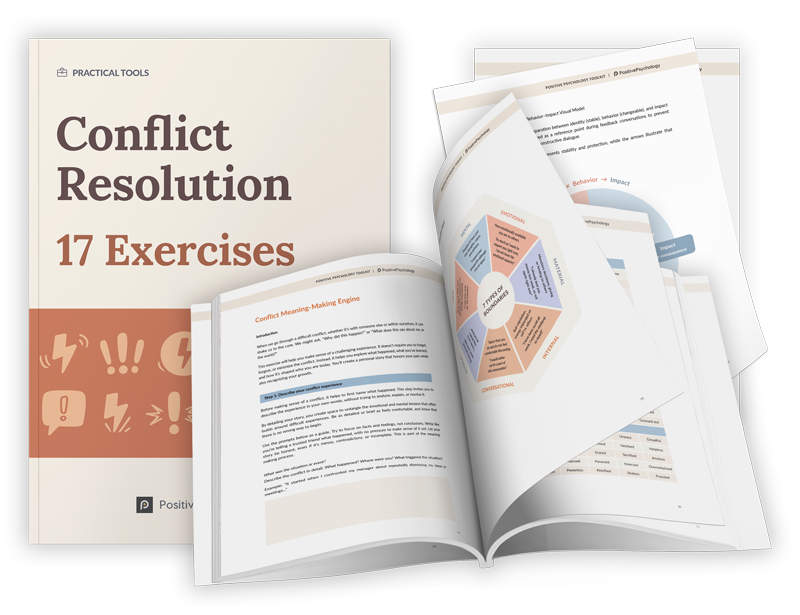
17 Conflict Resolution Exercises

Tools
(4 customer reviews)

Conflict is inevitable in human relationships — but how we engage with it determines whether it erodes connection or strengthens it.

True conflict resolution is not about avoidance or control. It is the capacity to stay regulated under tension, communicate needs clearly, take responsibility, and act in alignment with shared values. Research shows that constructive conflict builds trust, psychological safety, resilience, and long-term relational wellbeing.

This 17 Conflict Resolution Exercises [PDF] pack transforms evidence from relationship science and positive psychology into practical, ready-to-use tools. Each exercise helps individuals shift from reactivity to intention, from defensiveness to accountability, and from rupture to repair.

Designed for practitioners, coaches, and educators, these exercises make healthy conflict a skill that can be practiced, strengthened, and sustained.

$ 35

You will be equipped with the following tools:

  • Compassionate Limits Architect

    Help individuals bridge the gap between internal limits and external communication by using compassionate and assertive wording.

  • Conflict Meaning-Making Engine

    This tool functions as a guided psychological engine that takes a lived conflict experience as input and processes it through structured reflection, insight extraction, identity integration, and forward intention-setting.

  • Conflict Resilience Capacity Map

    Help practitioners support clients in evaluating their resilience capacity under ongoing or recurring conflict-related stress across emotional, cognitive, relational, and somatic domains.

  • Conflict Resource Reallocation Matrix

    Help individuals identify their habitual behavioral and emotional responses to conflict and intentionally choose one resource-building, values-aligned action that redirects emotional energy in a constructive direction.

  • Emotional Precision Protocol

    Help clients increase emotional precision in moments of relational or interpersonal stress.

  • Feedback Without Identity Damage

    This guidance offers practical advice for approaching feedback without damaging self-concept.

  • Future Integrity Simulator

    Help clients assess potential responses to a moral or interpersonal conflict through the lens of identity alignment and long-term relational integrity.

  • Micro-Repair Intelligence Tracker

    Help individuals develop micro-repair intelligence – the ability to notice early tension, choose small repair responses, and learn what helps a relationship return to balance.

  • Perspective Elasticity Profile

    Help clients recognize how their thinking (cognitive flexibility) and emotional flexibility (psychological flexibility) shift during high-stress conflict.

  • Perspective Elasticity Trainer

    Help individuals develop perspective taking skills through a guided reflection process.

  • Post-Conflict Nervous System Reset

    Help clients regulate their autonomic nervous system after experiencing conflict by restoring a sense of physiological safety.

  • Psychological Needs Translation Map

    Translate charged emotional language into clear, needs-based statements, using the framework of nonviolent communication.

  • Restorative Accountability Builder

    Help clients engage in meaningful conversations after interpersonal conflict by taking responsibility in a way that balances accountability with positive regard.

  • Strengths Collision Decoder

    Help clients reframe interpersonal conflict as a collision of strengths rather than a clash of personalities or failures.

  • Systems Ripple Forecast

    This tool is an aid for understanding how a specific conflict or unresolved issue can have a ripple effect across multiple life domains.

  • Trigger-to-Capacity Converter

    Help clients reframe emotional or behavioral triggers as developmental signals that identify emerging strengths.

  • Values Tension Integration

    Help clients identify two personal values that appear to be in conflict and to design a small behavioral experiment that integrates both values.


This pack includes 17 evidence-based exercises designed to strengthen constructive conflict resolution skills across personal and professional contexts. Each activity helps individuals regulate emotional reactivity, communicate underlying needs clearly, and engage in disagreement with greater steadiness and integrity — especially during moments of tension, misunderstanding, or relational strain.

Rooted in relationship science, positive psychology, and behavioral research, the exercises provide structured guidance, clear instructions, and practical applicability. Whether building perspective-taking, fostering accountability, supporting effective repair, or aligning actions with core values, this toolkit offers a flexible framework for developing lasting relational resilience.

Download the pack to transform conflict into an opportunity for clarity, connection, and growth.

The following experts create our tools and resources:

  • Jo Nash

    Ph.D.

  • Lorena Berber

    M.Sc.

  • Emma Mudge

    BSc (Hons), PGCert, PGDip

  • Lara Catic

    M.Sc.

This resource is designed for anyone who wants to better understand and navigate conflict in constructive, relationship-strengthening ways. It is ideal for individuals seeking practical, science-based tools to regulate emotional reactivity, communicate more effectively, and approach disagreement with clarity and confidence. It is also well-suited for coaches, therapists, educators, HR professionals, and organizational leaders who support others in developing healthier communication patterns, strengthening psychological safety, and fostering resilient, values-aligned relationships.

These tools are designed for adults who want to develop healthier, more constructive ways of navigating conflict. They are suitable for a wide range of life situations, including workplace challenges, relationship tension, family dynamics, leadership roles, and periods of change or stress. Flexible and adaptable, the exercises support adults in strengthening emotional regulation, improving communication skills, fostering accountability, and building relational resilience that promotes long-term wellbeing and psychological safety.

These tools are designed to be simple, flexible, and easy to integrate into everyday life. Each exercise includes clear instructions, practical guidance, and step-by-step support to help users apply the techniques effectively. They can be used independently for personal growth or incorporated into existing coaching, therapeutic, or wellbeing practices - allowing you to adapt them to individual needs and contexts.

Yes, each tool includes clear, step-by-step instructions, practical guidance, and thorough descriptions, making them simple to integrate into your current therapeutic or coaching approach. They are designed to be flexible and adaptable, allowing you to seamlessly incorporate them into your sessions with clients.

Upon purchase, you will receive access to a .zip file containing all the tools as PDFs. If you have any difficulty accessing the tools, please contact us at [email protected].

Absolutely! While these exercises are highly effective in professional and supportive settings, they are equally valuable for your own personal development. The same evidence-based practices that strengthen communication, emotional regulation, and accountability can support your individual growth. Whether you’re navigating workplace tension, relationship challenges, or difficult conversations in daily life, these tools offer practical guidance to help you respond with greater clarity, integrity, and confidence — transforming conflict into an opportunity for connection and growth.

Yes, these tools are adaptable for individual clients, groups, teams, and diverse client populations. You are encouraged to use your professional experience and expertise to tailor the tools to meet the unique needs of each client and scenario.

Yes, but in order to promote good practice, please note that you are advised to use the tools within the boundaries of your professional expertise. For instance, if you are a certified clinician, you are advised to use the training within clinical psychology.

Yes — all tools are grounded in established scientific research. Each exercise is informed by evidence from relationship science, positive psychology, behavioral research, and studies on emotional regulation, psychological flexibility, and interpersonal dynamics. This toolkit translates well-supported theoretical insights into practical, structured strategies that help individuals navigate conflict more constructively, strengthen communication, and build relational resilience. Every exercise is designed to be both research-informed and applicable in real-life personal and professional settings.

You’re free to download these tools in PDF format and print them for your personal or professional use, such as in a coaching or therapy setting. You’re not allowed to publish these tools publicly.

Within seven days of your purchase, if you decide that the tools aren’t for you, we’ll be happy to offer a refund.

Absolutely! Send us an email at [email protected] and we will gladly help you.

Description

Conflict is inevitable in human relationships — but how we engage with it determines whether it erodes connection or strengthens it. True conflict resolution is not about avoidance or control. It is the capacity to stay regulated under tension, communicate needs clearly, take responsibility, and act in alignment with shared values. Research shows that constructive conflict builds trust, psychological safety, resilience, and long-term relational wellbeing.

These 17 evidence-based exercises translate research from relationship science, positive psychology, and behavioral science into practical strategies for navigating tension constructively. Grounded in theory and supported by scientific insight, this tool pack helps individuals regulate emotional reactivity, communicate underlying needs clearly, protect identity dignity, engage in repair, and act in alignment with core values.

Each exercise is carefully designed to create meaningful impact in coaching, therapy, couples or family work, educational settings, organizational environments, and personal development practice — helping individuals move from reactivity to reflection, from defensiveness to accountability, and from rupture to repair.

  1. Dr Joanna Blatter-Minn –

    I find this tool pack both impactful and insightful—not only for mental health practitioners, but also highly valuable for Mediators, Human Resources professionals, and Managers. It supports the development of self-awareness, helping individuals recognise potential triggers and, importantly, equipping them with practical strategies for responding effectively when faced with them. Beyond its professional application, I see this toolkit as equally beneficial on a personal level. It is thoughtfully presented, with a clear, integrative, and comprehensive introduction that frames the underlying structure in a concise and relevant way.

    Dr Joanna Blatter-Minn Mental Wellness Counsellor

  2. Selin Ozuslu, MSc –

    I found the Conflict and Resolution exercises exceptionally helpful. As a professional, I appreciated that the exercises included both an educational component and space for reflection. I also found it extremely valuable that most of the exercises shift the narrative toward understanding unmet needs, which is the most crucial part of this work. I highly recommend these tools for personal use as well as for use with clients!

    Selin Ozuslu, MSc Psychologist

  3. Edwyn Kumar –

    Having effective tools to manage conflict is vital to ensuring that the best possible outcomes are achieved, especially amongst leaders in a business setting. The Conflict Resolution Exercises provide clear direction and allow the root of the issue to be explored with clarity and confidence. There’s practicality and discernment woven into the exercises that gives everyone involved the confidence to move forward. As an Executive Coach, it’s an absolute must have!

    Edwyn Kumar Executive Coach

  4. Ma. Sheyna Elayne G. Delos Reyes –

    I found the Conflict Resolution Exercises to be clear, practical, and highly accessible from a facilitator’s perspective. The tools are thoughtfully designed to support psychological safety, making them especially well suited to peace education workshops with young people and educators — particularly sessions focused on mindfulness, cultivating inner peace, emotional regulation, and restorative communication.

    Ma. Sheyna Elayne G. Delos Reyes Peace Education Practitioner

Add a review

Your email address will not be published. Required fields are marked *

*

[]